

Enter the 4th Chamber
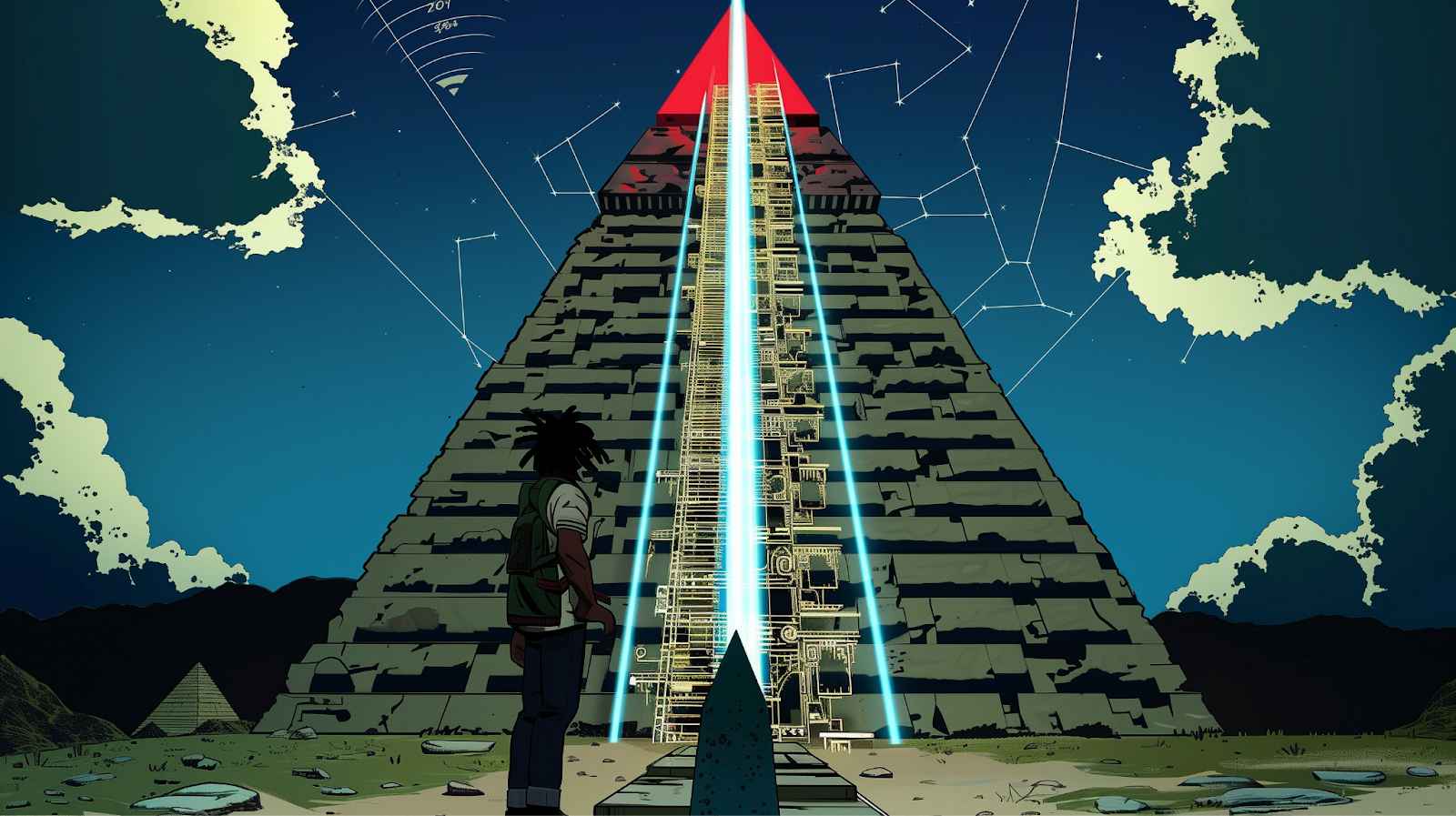
You stand before the door to the 4th Chamber.
Behind you: three chambers of preparation. In the 1st Chamber, you learned balance—how to find your center when the world tilts. In the 2nd Chamber, you understood the elements and seasons, the cycles that govern all living things. In the 3rd Chamber, you mastered your breath, that bridge between body and spirit, the mathematics of life force itself.
You have cultivated power.
But here’s what they don’t tell you about power: without direction, it’s just chaos wearing a crown. Without structure, it’s a storm that destroys everything it touches, including you. The first three chambers gave you the engine. The 4th Chamber teaches you the programming language.
Welcome to the SOFTWARE of the soul.
The Fragmented World
We live in an age of specialization. Pick any two experts from different fields and watch them struggle to communicate basic concepts to each other. A quantum physicist and a jazz musician might both be exploring similar patterns of resonance and interference, but they lack a shared language. An AI researcher and a meditation teacher might both be investigating the nature of consciousness, but they can’t coordinate their findings.
This isn’t progress. This is what canon collapse looks like.
Almost a decade ago, I began researching the origins of foundational civilizations—Kemet, Greece, China, and India. I was looking for patterns, commonalities, the universal grammar underneath cultural expression. What I found changed everything.
Every civilization that achieved what we’d call “advancement” shared something in common: a unified framework for developing human consciousness. Not just knowledge accumulation, but systematic consciousness expansion. These weren’t separate subjects taught in isolation, they were interconnected technologies that formed a complete operating system.
Some people even believe that civilization itself can be defined as people living under the same canon. Not the same beliefs, but the same meta-framework that allows different beliefs to communicate. A shared protocol for reality.
We’ve lost that. And the fracturing shows everywhere.
The Ancient Canon
The civilization we now call ancient Egypt—they called it Kemet, “the Black Land”—understood something profound about consciousness technology. Their educational system wasn’t about creating specialists. It was about creating complete human beings capable of wielding knowledge like a tool, consciousness like a craft.
They called their wisdom tradition Sebayt. The word literally means “teachings” or “instructions,” but it carried a deeper meaning: the systematic cultivation of human potential through precisely sequenced knowledge transfer. Sebayt wasn’t a school subject. It was an operating system for human consciousness.
The Kemetic framework consisted of these foundational elements:
Language and communication (medju neter, the “words of God”)
Mathematics and proportion
Geometry and spatial relationships
Music and harmonic ratios
Astronomy and celestial cycles
Logic and discernment
Rhetoric and persuasion
Sound familiar?
These weren’t arbitrary subjects. They were the Seven Liberal Arts before the Greeks gave them that name. When scholars like Pythagoras and Plato traveled to Egypt to study in the mystery schools, they weren’t discovering new knowledge—they were translating an existing canon into their own cultural context.
The Greeks did what all great students do: they preserved, codified, and transmitted. They organized these disciplines into what became known as the Trivium (grammar, logic, rhetoric) and the Quadrivium (arithmetic, geometry, music, astronomy). Three arts of expression plus four sciences of measurement. A complete consciousness technology disguised as classical education.
The Lineage Flows
Here’s the lineage clearly:
KEMET (3000 BCE - 30 BCE)
Sebayt: Consciousness cultivation as sacred technology
Mystery schools teaching unified knowledge
Medju neter: Language as creative force
Ma’at: Truth, justice, and balance as foundation
↓
GREECE (800 BCE - 600 CE)
Translation and codification of Egyptian knowledge
Seven Liberal Arts formalized
Trivium + Quadrivium structure established
Preservation through philosophy schools
↓
MEDIEVAL EUROPE (500 CE - 1500 CE)
Monastic preservation of classical knowledge
Liberal Arts as university curriculum
“These be sciences seven, Who useth them well, may have heaven”
Connection between consciousness cultivation and spiritual advancement
↓
RENAISSANCE (1300 CE - 1700 CE)
Revival and expansion
Integration with emerging sciences
Art as applied consciousness technology
↓
MODERN FRAGMENTATION (1700 CE - Present)
Specialization replaces integration
Knowledge silos
Canon collapse
The operating system fragments
But here’s what’s interesting: whenever a culture loses its canon, someone always reconstructs it. Not consciously, not deliberately, but through necessity. When people need a framework for consciousness expansion and don’t have one, they build it from first principles using whatever materials are available.
This is what happened in the latter half of the 20th century.
The Modern Reconstruction
I’m not going to name names or point to specific movements. But if you look at certain cultural frameworks that emerged in the late 20th century, you’ll see something fascinating: they’re isomorphic with the ancient systems. Different cultural expression, same underlying structure.
Take, for example, a five-element framework that emerged from African American urban culture:
Knowledge of Self — Understanding your base programming (Grammar)
Verbal Expression — How you transmit meaning through language (Rhetoric)
Musical Pattern Manipulation — Understanding rhythm, timing, cycles (Music/Arithmetic)
Visual Spatial Marking — Symbolic representation in physical space (Geometry)
Physical Movement as Language — The body as instrument of cosmic principles (Astronomy/Physical Geometry)
This isn’t coincidence. This is consciousness technology spontaneously reconstructing itself because humans NEED a complete framework to make sense of reality.
Or let’s take a look at the foundation traditional African spiritual frameworks explained by Marimba Ani:
Ethos — The moral foundation
Emotion — The energy that moves knowledge from abstract to embodied
Language — The transmission system
Ritual Drama — The enactment that makes teaching tangible
Music — The harmonic structure underlying reality
Dance — Embodied knowledge
Visual Arts — Symbolic representation
Spiritual Reality — Connection to lineage and forces beyond the individual
Divination — Ability to forecast and predict the cycles and pattersn
Again: different cultural expression, same underlying structure. These are all the same system adapted to different contexts, like different operating systems running on the same fundamental computational principles.
Why does this pattern keep repeating?
Because there’s something about human consciousness that REQUIRES these seven faculties to be developed in order to function at full capacity.
SOFTWARE and HARDWARE
Now here’s where it gets interesting.
I made a distinction between SOFTWARE and HARDWARE earlier about spiritual technology.
SOFTWARE = Instructions, frameworks, protocols
The Seven Liberal Arts themselves
Sebayt teachings
Ritual formulas (what the Kemetic tradition called heka)
Meditation techniques
The 42 Chambers system
HARDWARE = Physical tools that embody and transmit principles
Musical instruments (geometry + harmonic mathematics made physical)
Martial arts weapons (force multiplication through geometric principles)
Architecture (frozen mathematics you can walk through)
Writing systems (thought made permanent)
Computers (logic gates manifested in silicon)
The genius of Kemet was that they didn’t separate these. The pyramids aren’t just buildings, they’re cosmological computers. They encode astronomical knowledge in stone. Stand at Giza during the equinox and the structure TEACHES you through direct experience. The shadow movements, the alignments, the proportions.. they’re all HARDWARE running EDUCATIONAL SOFTWARE.
When you walk through a Gothic cathedral, you’re experiencing the same principle. The architecture was designed to transmit specific states of consciousness through proportion, light, and spatial relationships. The building itself is teaching technology.
Modern example: A sampler is a time-manipulation device. It lets you capture sound from any point in history, alter it, recombine it, and transmit new meaning. When artists began sampling kung-fu films and classic soul records in the 1980s and 90s, they were using HARDWARE to run new cultural SOFTWARE. They were doing what the Kemetic priests did—using physical tools to manipulate consciousness and transmit knowledge.
The tools change. The principles remain constant.
The Seven Faculties
Why these seven specifically? Why not five, or nine, or twelve?
Because these seven faculties form a complete circuit of consciousness development, a divine cipher:
Grammar — Pattern recognition, the fundamental structures of meaning. You must recognize patterns before you can manipulate them.
Logic — Discernment, the ability to separate truth from illusion. You must distinguish signal from noise.
Rhetoric — Expression and transmission. You must be able to externalize internal understanding.
Arithmetic — Quantification and proportion. You must grasp the language of numbers.
Geometry — Spatial relationships and sacred proportion. You must understand how things relate in space.
Music — Harmonic ratios and temporal patterns. You must feel the rhythms that structure reality.
Astronomy — Cycles and your place in the cosmic order. You must know where you are in space and time.
Each faculty builds on the others. Grammar provides the foundation for Logic, which enables Rhetoric. Arithmetic illuminates the patterns studied in Geometry, which reveals the structures underlying Music, which reflects the cycles of Astronomy.
It’s a self-reinforcing system. A complete technology for human transcendence.
Medieval scholars understood this. They didn’t view these subjects as separate courses, they saw them as passions of the soul made manifest through disciplined study and practice. The phrase wasn’t “the seven subjects.” It was “the seven liberal arts”—liberal from the Latin liber, meaning “free.” These were the arts that made you free. Free from ignorance, free from manipulation, free to navigate reality consciously.
The Modern Application
In my lifetime, I’ve used these seven faculties to master what I love:
Martial arts taught me geometry and logic—how angles and leverage multiply force, how to read an opponent’s intent.
Technology and coding showed me arithmetic and grammar—how patterns repeat, how systems build on themselves.
Music and rhythm gave me direct experience of harmonic mathematics—how beats synchronize with breath, how frequencies interact.
Observing celestial cycles—equinoxes, solstices, moon phases—reconnected me to astronomy, to the understanding that I’m part of a larger cosmic dance.
Dance culture, sci-fi aesthetics, video games, fantasy literature—all of these became vehicles for exploring geometric principles, rhetorical strategies, and logical systems.
I didn’t set out to study the Seven Liberal Arts. I set out to master my passions. But when you pursue mastery deeply enough, you discover you’re always circling back to the same seven core principles.
Because these aren’t arbitrary academic subjects.
They’re the fundamental operations of consciousness itself.
What the 4th Chamber Teaches
The first three chambers prepared your instrument. Now the 4th Chamber teaches you the operating system.
When you understand the Seven Liberal Arts as consciousness technology, not as school subjects but as spiritual disciplines, you gain something profound: the ability to see the same patterns operating across completely different domains.
You start to notice:
The mathematician and the musician are studying the same relationships, just in different languages
The martial artist and the architect are both working with geometric principles
The poet and the programmer are both manipulating symbolic systems
The astronomer and the farmer are both tracking cycles
You begin to see the META-PATTERN, the grammar underlying all grammars, the geometry of thought itself.
This is what “canon” means in its deepest sense: a shared framework that allows different domains to communicate. Not uniformity.. INTEROPERABILITY. Different applications running on compatible operating systems.
And when you have that meta-framework, you can:
Translate insights from one domain into another
Recognize patterns emerging before others see them
Build bridges between seemingly separate fields
Innovate by combining principles in novel ways
TEACH effectively because you understand the underlying structure
This isn’t just knowledge accumulation. This is consciousness expansion as technology.
The Stakes
We’re entering an era where consciousness technology isn’t metaphorical! It’s literal.. Brain-computer interfaces, AI language models, virtual reality systems, genetic modification. All of these are attempts to program consciousness from the outside.
The 4th Chamber teaches you to program it from the inside, using methods refined over five thousand years.
As external consciousness tech accelerates, internal consciousness tech becomes survival knowledge. Not just for individuals but for our species. Because without a shared canon, without a common protocol for reality, we can’t coordinate. We fragment. We collapse.
The work we’re doing here, reconnecting these lineages, making explicit what was implicit, translating ancient wisdom into contemporary language.. This is civilizational repair work.
The 42 Chambers is a canon-building exercise. Not the canon—we’re not trying to create a monoculture. But a canon, one possible framework that honors the ancient lineages while remaining open to new discoveries.
One possible answer to the question: How do humans develop consciousness systematically?
What Comes Next
You’ve now entered the 4th Chamber. You see the system. You understand:
The Seven Liberal Arts are consciousness expansion technology
This technology has ancient roots with origins going back to the dawn of time itself
The same pattern keeps reconstructing itself across cultures
SOFTWARE (instructions) and HARDWARE (tools) work together
These aren’t seven random subjects—they’re a complete circuit
But understanding the WHAT and the WHY is just the first step.
Next comes The Dao of the 4th Chamber—where we’ll explore the PRINCIPLES. How each art actually operates. How they interconnect. The philosophy that makes the system coherent.
After that comes The Basics of the 4th Chamber—where we’ll get PRACTICAL. Specific exercises to develop each faculty. How to train your consciousness systematically. The actual techniques.
For now, just sit with this:
You’ve been using these arts your entire life. Every time you count a beat, navigate a room, craft a sentence, persuade someone, solve a problem, listen to music, or watch the moon, you’re running ancient consciousness software.
The 4th Chamber just teaches you to do it consciously, systematically, and powerfully.
Welcome to the programming language of reality itself.
The door is open.
Will you enter?


